Sunday, October 20, 2013

220) Mt Remarkable to the Flinders; S Australia

Unidentified pretty spring flower


The woods along the creek in Mt Remarkable National Park were glorious.


But as I hauled a big piece-o-glass for making far-away-little- things look close..........


.......Nancy's camera was responsible for making close-by-small-things look huge!

I'm really glad these things don't lunge!


Flowers that we can't identify, but were pretty to find


A tiny orchid!


a big burned out tree. These trees have obviously evolved in a fire-regime. Many were hollow and burned but still solid and healthy looking


Early morning light was so pretty in the overarching trees.


Re-enacting "old-man-willow"!

Dirk funning around -


We love the big birds wandering around camp--no problem identifying the Emus!


We finally had to tear ourselves  away and hit the road. This is our fine mobile hotel-room. As we are heading into dirt-track country we hired a full-on 4X4 all tricked out for camping. The roof-tent was fun and became pretty quick to set up. It is not encouraged for sleep-walkers though!

 Bits and pieces from a homestead from the days when the park was a sheep station. It was north of Goyder's line, which is a rainfall isoline across South Australia believed to indicate the edge of the area suitable for sustainable agriculture


Still in farm country with big fields of canola


Urdlu Warlpunha (The Flinders Range) -- a place to set out your swag and have a good sleep

Next - stakeout at Stokes Lookout. Watch this space for breathless excitement!


Saturday, October 19, 2013

221) Seeking snipes


Latham's Snipe
Here's a collection of photos from around the local 'hood.'  

We found snipe without even looking for them, how lucky is that?!  A complete surprise to us, we saw this guy completely in the open, foraging in the mud.  At first we thought, sandpiper?  But closer inspection revealed his large, dark, eye, set far back on his head--classic snipe.  Their intricate plumage is superb camouflage in mud and sticks. Cool! Since we felt lucky, the next day we went seeking another snipe--the 'Painted Snipe.'  We dipped on them, but were fortunate to spot eight more Latham's Snipe at at nearby wetland--what's going on?


White-browed scrubwren

Though he looks a bit severe with those eyebrows, these little birds have a companionable, scolding twitter and flit about low in the canopy with attitude
Buff-banded Rail


Tawny Grassbird


Reed Warbler


This bird was a 'driving-along-at-80k-stop-the-car' bird.  Something about his profile caught our attention.  These little rails are usually shy and secretive, but it was early morning and he woke up to find himself hungry and in need of getting out and about even though he was in a park in suburbia along a busy road.


Tawny Grassbirds are more often heard than seen, as are Reed Warblers.  As you would expect from their names, Tawny Grassbirds hang out in dense stands of tall grass, and Reed Warblers hang out in reeds in which they are usually infuriatingly impossible to see. These birds were extremely cooperative, maybe they were out for some fresh air and a change of scenery before roosting for the night. 


Glossy Ibis

In the right light (like here) the iridescent plumage of these birds is stunning.  In the wrong light, they look like a black curlew.  They're not nearly as numerous as their trash-loving white ibis cousins.  These guys stick to the obscure wetlands.


Yellow-billed Spoonbill

These guys motor along sweeping the water with their bills.  I thought they were filter-feeders, so was surprised to learn that in the inside of their bills, the 'spoon' has vibration detectors with which they find their prey.  They they scoop it up to let slide down their throat.  They eat aquatic insects and larvae. (www.birdsinbackyards.net)


White-faced Heron


Spectacled Monarc
White-faced ibis are sometimes the wallflowers, they are not real conspicuous or showy birds.


We're happy to see the monarchs when they migrate back at the beginning of summer.
Water Dragon

Catching some 'rays.

We also like to see the Drongos back for the summer. Apparently our (eastern AU) Drongos migrate to New Guinea for the winter,whereas Northern Drongos go to Indonesia (www.birdsinbackyards.net).  Here, apparently the phrase 'don't be a drongo' is slang for 'don't be a dope.'  Maybe it's just because the drongos look a little crazed with that blood-red eye, but they seem pretty smart to us.  They're always alert and on-the-ball.
Sharp-tailed Sandpipers
Finally, we're trying our hand at identifying shorebirds (it's a real bonus to be able to look at the freeze-frames in Dirk's photos!).  We're asking Santa for a scope for Christmas so we can look more closely at them.  Since most shorebirds come to Australia after their breeding season in the northern hemisphere, we get the extra challenge of trying to identify them in their non-breeding plumage. These were surprising to find, as this wetland is a bit inland and we think of sandpipers as being coast-loving birds.
Great Egret
Whistling kite

Great egrets are very tall and stately and have a characteristic 'kink' in their neck rather than a smooth bend like the other egrets.


We like the Whistling Kites for being easy-to-identify birds-of-prey.  They tend to 'whistle' alot--a sound we always associate with Kakadu and the Northern Territory where they are numerous--and as they fly overhead, the contrasting colors in their wing feathers spell out a 'W'. This one has an eel it grabbed from another bird down in the wetland.


Grey Butcherbird

Oddly enough (to us), grey butcherbirds seem uncommon down here on the Gold Coast, but more common just an hour north in the Brisbane area (they hang out on the UQ campus.  This guy was busily catching bugs paying us no-never-mind.  On the other hand, the Pied Butcherbirds are one of our backyard birds.  They are the early risers, beckoning me out of bed to hear their beautiful and haunting welcome to the morning.  They also sing from under the eaves of the deck during rainstorms, seeming to practice their calls so they don't get bored waiting out the storms.


OZ has an odd attitude about fireworks - pretty much an all-purpose event - start of the semester, end of the semester, first day of the month, last day of the month, Canada-Day (huh?). This is the start of the semester from my office window.

Sunday, October 6, 2013

219) Inskip and Return

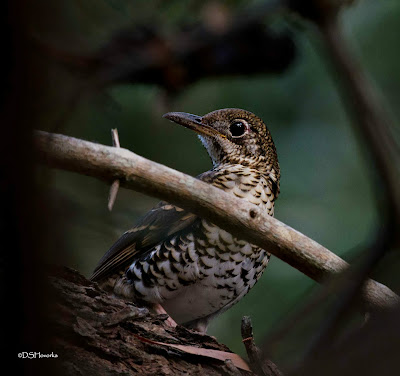
Russet-tailed Thrush

We had been planning for ages to get ourselves up to Inskip Point, just south of Fraser Island.  We wanted to see if we could spot a rare little bird that is endemic to Eastern Australia, the Black-breasted Button-quail.  Whereas this area has been known as being the best place to see these birds in Australia, its habitat is rare and fragmented and the birds are vulnerable to population-collapses (local extinctions).  Unfortunately, we may be too late at this locale.  We subsequently found out that the general consensus is that the local population has crashed, and only 1-2 birds may be left in the area.   While wild dogs and goannas have been blamed, we were shocked at the number of people and vehicles in the area, and the condition of the habitat--toilet paper was strewn about, and the small area appears to heavily impacted by people and traffic.  Despite two days of searching, we didn't see any of the birds.  We did find platelets, areas where the buttonquails scratch the ground looking for bugs.  Dogs, cats, large lizards, people, cars...a lethal mix for little ground-dwelling sedentary birds, the odds aren't good this population will recover. 
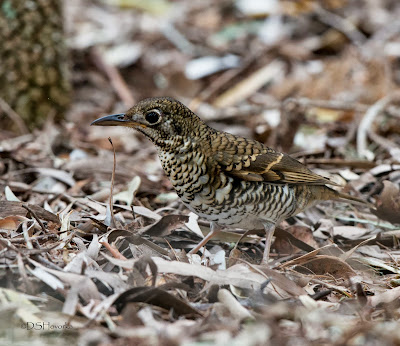
Russet-tailed Thrush
White-eared Monarch

We tried to let the other lovely birds in the area cheer us up.  These Russet-tailed thrushes were hopping about on the ground, see how cryptically they're colored?  Every time we saw them we hoped for  buttonquails, but really they're nice enough birds in their own right. We ID them as Russet-tailed thrushes...the Bassian thrushes look similar, but live at higher elevations.  You can't get much lower in terrestrial elevation than sea-level.


We were totally surprised to find two White-eared Monarchs--a new species for us.  These birds are infrequently found this far south, they're more of a tropical species.  We didn't find them when we were looking for them up in the tropical Cairns area last year, so were pleased to hear them singing and see them cavorting about.  This bird was generous to pose nicely, but briefly, for us--enough to get the all-important ID!


Leaden Flycatcher (female)


This female Leaden Flycatcher is more brightly colored than her partner--he doesn't have the pretty rufuous throat that she does.  The leaden grey does reach further down the male's breast.
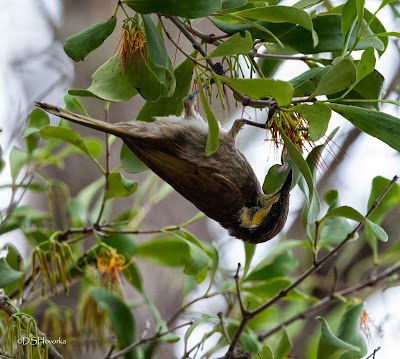
Mangrove Honeyeater
Varied Triller

White-cheeked Honeyeater


Here's a new bird for Dirk.  A Mangrove Honeyeater works for his breakfast--he sips each individual flower at lightning speed.


We like seeing Trillers, but don't have the opportunity to see them very often.  They're just not around that much so, it's a pleasure to spot them--they're pretty birds and have a nice call.


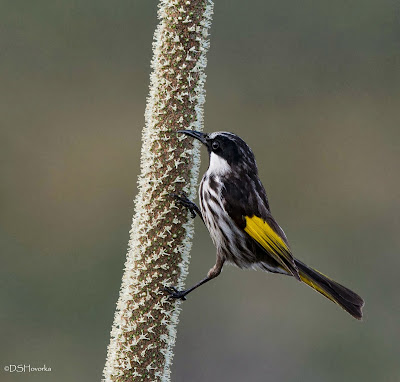
A White-cheeked honeyeater is feeding on the nectar from a Xanthorrhoea (grass tree) flowering spike.  It was a treat to see plants blooming in the heath along Cooloola Way in Great Sandy National Park. While these honeyeaters were the most commonly-seen bird in this area, we didn't get tired of watching them.  Don't they sport a brilliant plumage?
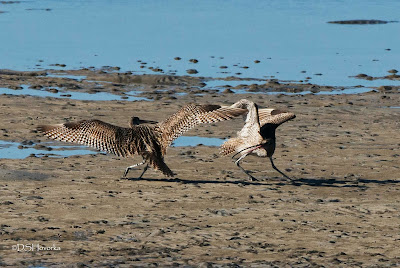
Eastern Curlews
Funny that we always think of shorebirds as 'mellow' types.  I mean, geez...these Eastern Curlews just flew 12,000 km from Siberia, you'd think they'd be tired enough not to fight.  But maybe that's the problem.  We know I get cranky when I'm hungry--maybe they're fighting over territory in their feeding grounds.  'Endless summer' lovers, they divide their time between the northern and southern hemisphere summers.
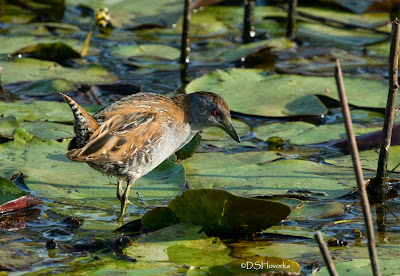
Ballion's crake


Dirk insisted we stop off in Brisbane in the hope we'd find a recently reported nomadic/migratory bird, the Ballion's Crake.  Luckily, they cooperated and hung out just for us! We found three of them feeding in the late afternoon out in the open on the lily pads.  Surprising hard to spot when the wind is rustling the lily pads (they are tiny), they are wonderfully beautiful birds--gotta love that clear red eye and pajama-stripey butt!
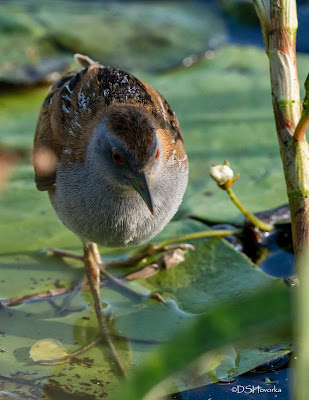
Ballion's crake


Tuesday, September 17, 2013

218) A Three Desert Tour


OK - I was close. This is desert birding.....
Not a trip to be taken lightly (yes, people do die out there), Dirk has been carefully planning our trip to explore the central (Tirari, Strzelecki and Simpson) desert region of Australia for during late winter/early spring to make sure we arrived well before the heat.  We wanted to avoid the potential of experiencing last summer's temperatures, when the Bureau of Meteorology added new colours to their maps to represent the record-breaking temperatures in this region (max 50.7 C = 123 F; increasing average).


So here's a map of our route through South Australia, beginning and ending in Adelaide.  Overall, we drove 4200 km (damn big place)!  Most of the roads are dirt, ranging from wide and well-maintained major thoroughfares to bone-shaking corrugated tracks to sand dunes. Except for the most southern region, everything north of the Flinders Range was quite dry.  So we planned for artesian bores (drilled to support the old cattle routes that stretched through the region), lakes and areas that had been flooded in the massive rains in 2009-2011 when water flowed across Queensland down to fill Lake Eyre. We missed that rare event, but hoped to track some of the birds which followed those massive water events.

Our first stop (after a massive grocery purchase) was Mt Remarkable National Park, south of the Flinders Range. The trail along Mambray Creek was delightful!  Clear, cool, water was sparkling down the creek in the morning light, the lively birds were darting amidst the Red River Gums set against a verdant green understory, and we were happy to be out and about exploring in a new and exciting place. Right out of the campground we spotted Adelaide Rosellas - a local variant of the Crimson Rosellas common up 'north' (in our area).


Things were gloriously green and the 'roos were out in force, with the little joeys experiencing the salad days of springtime.


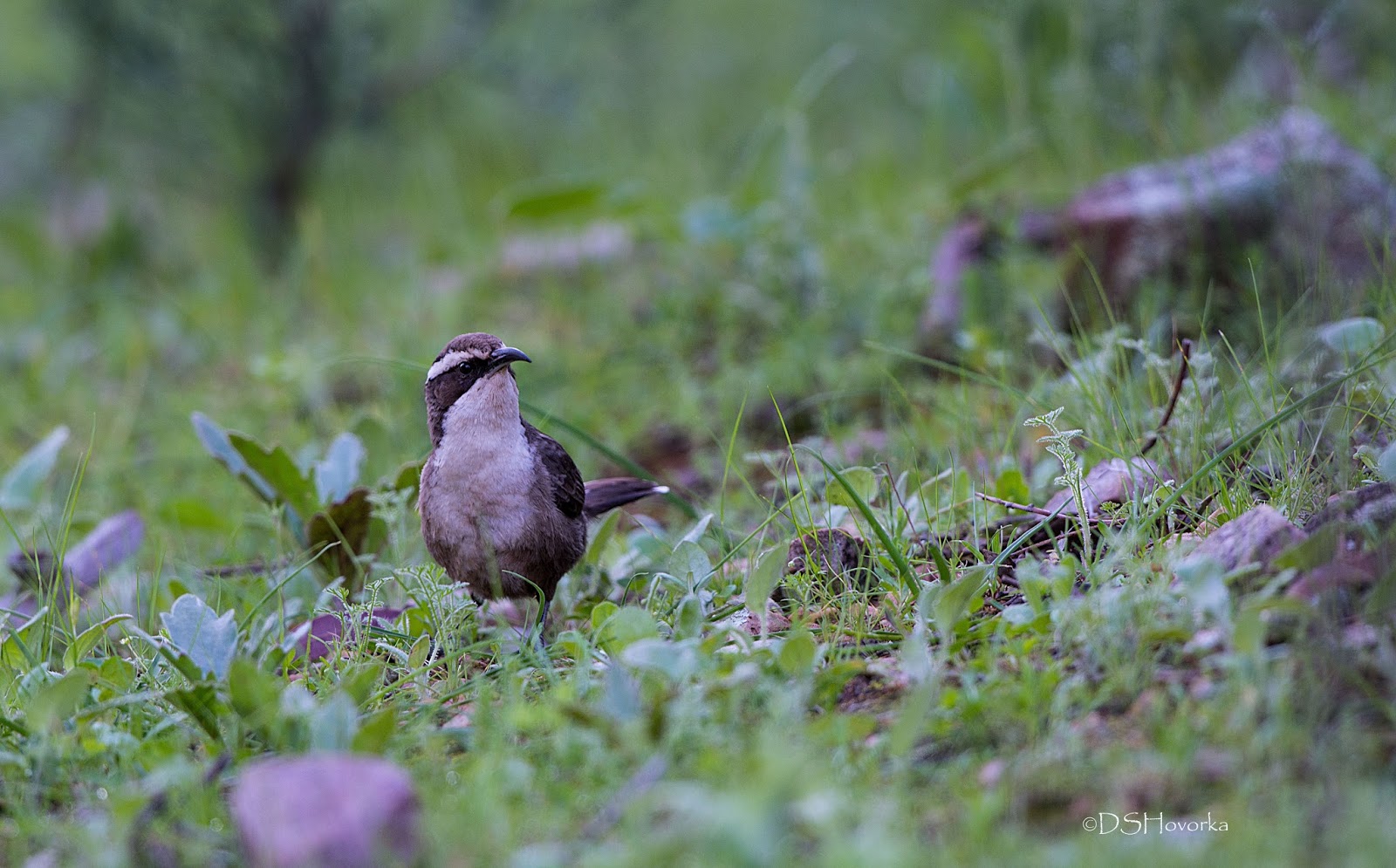
 Nancy was thrilled to find a family of one of her favourites - White-browed Babblers yakking away as they moved through the landscape, looking for bugs to eat and for new sticks for their communal nests.


The rosellas were nesting too, and the glorious old Red River Gums with their fantastical shapes harboured many safe hollows for lots of birds to tuck their nurseries safely inside.


Grey Fantails zipped about, finding plenty of bugs to snap out of the air and fill their hungry bellies.