Sunday, May 17, 2015

255) More New Zealand


At  Te-Reinga - the place where spirits enter the underworld on the N tip of NZ- is a lone kahika tree - Te Aroha. The spirits descend to the water on the tree's roots and continue to their spiritual home - Hawaiki


 Dirk contemplate the lighthouse at Cape Reinga overlooking the meeting between the Tasman and the Pacific Ocean.


One of the eclectic cottages at Pagoda House in Kerikeri on the east coast. Each cottage is unique, from a truly tiny tree-house (where I stayed) to lavish platforms tents, an old tugboat, these gypsy-caravan themed cottages, and  a  refurbished 1950's trailer.


 No trip up the East coast would be complete without a stop at the bathroom in Kawakawa designed by the 20th century architect Friedensreich Hundertwasser. Note the  wine bottles forming the entrance wall.


The Saddleback is another of the NZ conservation success stories. From a population of 500 birds on one island there are now an estimated 7000 birds relocated on 11 islands. The related huia was last seen in 1963 so its not all good.


A Whitehead with breakfast on Tiri-tiri


Ah -- there are things in the deep here!

Sunday, March 15, 2015

254) Land of the Long White Cloud


Tui dispersing pollen from NZ flax flowers
My major academic conference was in New Zealand so December was an opportune time for us to return.  Post conferencing Nancy came down and we toured the sanctuary 'islands' (both literal and figurative) of the N. Island. Once populated with many amazing species, NZ has seen 25% of its native species go extinct and many more at on the edge. Although human impacts play a role, one of the biggest contributors are introduced species - rats, mice, stoats, Australian possums. As they attempt to slow the loss of birds, conservation-minded kiwis (that is, inhabitants of New Zealand) have taken to extreme measures (see "The Big Kill" http://www.newyorker.com/magazine/2014/12/22/big-kill) and have miraculously created "pest free" islands off-shore and fenced sanctuaries on the mainland.


At Reinga Lighthouse

I headed to the far north point of the Northern Island while waiting for Nancy's arrival. Point Reinga is a wonderful place where spirits depart the land. The history of the area weighs heavy as the cleared fields attest to the  timber and Kauri Gum industries which the residents depended on.


Takahe

Whitehead


A number of NZ bird species went to the wire. Once thought extinct, a relict population of Takahe was"rediscovered" in 1948 high in the mountains at the extreme of their range.  At one point their population dropped to 118 birds - current estimates are about 250 adult birds. This is one of a breeding pair on Tiri-tiri Matangi, an amazing predator-free island just a 30 min ferry ride from Auckland. 
Kereru (New Zealand Pigeon)


The little Whiteheads (Popokotea) were a bit hard to spot sometimes, but they had cheerful little chirps and whistles and moved about in sociable flocks.


The Kereru are big beautiful birds.  A bit clumsy, they often gave themselves away when thrashily flying through the forest and landing heavily on bendy boughs. 


Korimako (Bellbird)

The Korimako have a lovely clear bell-like song.  Like the Tui, they have a noisy whirring flight.  We would have loved to hear the songs of the forest when the New Zealand birds were plentiful--they have such beautiful songs. This is a bird on Tiri-tiri - note the banded legs for identifications)


Silvereye (pollen on forehead)
Silvereye are relative newcomers to New Zealand, they get around and about.  They're also present in Australia.  This one is feeding on flax flowers - thus the pollinated forehead!

Sunday, November 30, 2014

253) Festival of Fairywrens

Splendid Fairywren
We finally made time to head to Round Hill - an ecological island 500 km inland. It is an island in that there are some endangered species there which are geographically separated from the rest of their range (as if they were on an actual island). We were pleases to find a good number of Splendid Fairywrens  in their breeding-plumage glory.

Splendid Fairywren (Female)


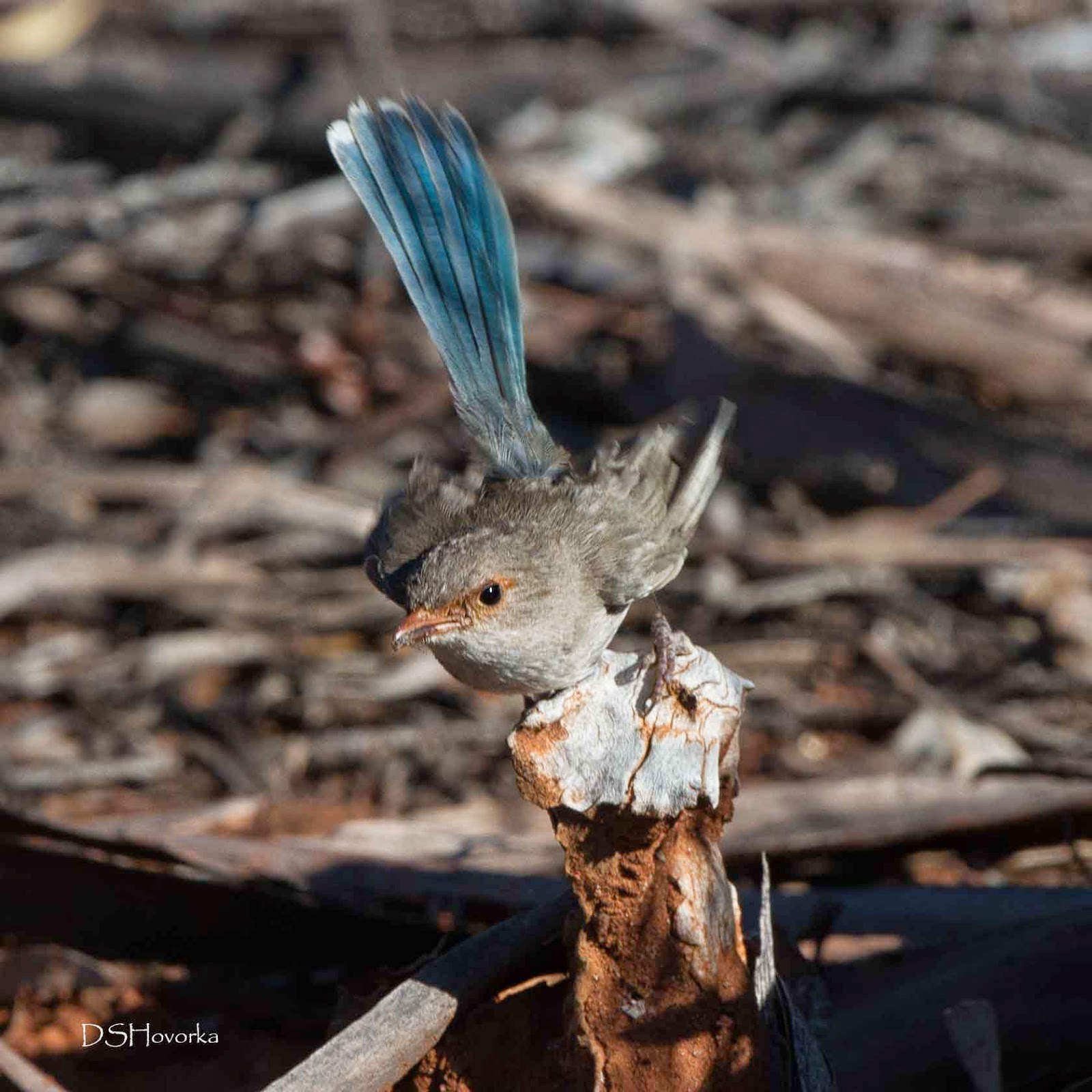
The females were delightful, flitting about with their tails swishing to and fro.
Splendid Fairywren


Variegated Faireywren

We also had good views of beautifully plumaged Variegated Fairywrens


Variegated Fairywren
A wonderful find in some roadside saltbrush was a family of White-winged Fairywrens. With some patience I finally got a reasonably close view of one of the males - they are quite shy and keep their distance.

Inland Thornbill
We also spend some time determining the differences between the Inland Thornbill (here)...
...and the Chestnut Rumped Thornbill. Fast, twitchy flyers and really really similar!


Brown Songlark

Brown Songlark in full breeding plumage. What was striking was the size difference between the males and females (below)


Southern Scrub-robin


We were happy to find a few scrub-robins who were happy to lead me on a merry chase out into the malee (always an issue when you can't see the car and can't see anything but endless dry trees. No landmarks at all!)


Red-capped Robin (female)

The female Red-capped Robins were happy to pose - the males were about but far skitchiyer..


On returning to camp we were pleased to find a small flock of Southern Whitefaces around our tent. We have seen them (rarely) singly before but never in a flock.


Nancy also found this amazing Shingback - prehistoric! This is his threat-posture as Nancy crouched to take a picture (as I sensibly stood 10 feet away ready to rescue her!)


Unfortunately our choice of weekends could have been better. We didn't find any of the unusual species we had hoped for - it has been really dry in the region and we picked the hottest weekend on record (for November - 43.7 C (110 F)!

So we will return come cooler temps to search, once again, for the our desired list....


Tuesday, November 11, 2014

252) A Quick Jaunt Down South

Flame Robin
I had a workshop in Canberra (Australia's capital - 3 .5 hrs south) and Nancy took the bus down to join me to explore some new terrain afterwards. We enjoyed the Rose Robins in Brisbane as we left, the Scarlet Robins in SE QLD and finally had some good sighting of the Flame Robin in one the great 'urban' birding areas just outside Canberra (a woodland right next to a large office park).


For comparison, here is  Scarlet Robin we saw in Buderoo National Park near Sydney  two days later. More black than grey and less red on the chest.


Superb Parr


Another major draw were the Superb Parrots that are doing very well in the green areas of the city. We had met  Canberra locals Tony and Cathy on a wildflower hike in N. Sydney and they graciously took us to the Olympic Training facility (parrots in the trees in the parking lot) and then to  a green belt in the 'burds where blooming trees were a draw for a heap of Superbs. Australia parrots are just amazing.....

White-winged Choughs


They also took us out to Mulligans flat - a predator-proofed (fenced) nature reserve N of town. It was pretty dry but we did did find this group of 8-10 White-winged Choughs fighting over who got to sit on the nest! They are communal nesting birds who share duties but it was quite a raucous ritual!


Southern Emu-wren

Back in Royal National Park I made another pilgrimage to Watamolla (a beach with good heath on the cliffs above) and got a slightly better photo of a Southern Emu-wren. This is one of Australia's smallest birds if you consider the tail is 2/3 its total length! They are quite shy and I am still on a mission to obtain a better photo.


Monday, October 6, 2014

251 Everyone is twitter-pated in the Spring!


Eastern Yellow Robin
Springtime is in the air!  And the birds are a-nesting.  We've seen more nesting birds this year than ever, probably just because we're looking for them in habitat where we can spot the nests. We've been observing the birds for a few minutes to see what it is they're doing as they go about their lives, and so get some glimpses into all their hard work.  This pair carefully camouflaged their nest with lichens and pieces of bark.  We wonder how in the world they cleverly got the bark strips to stick onto the outside of the nest like that!

Spotted Quail-thrush
We heard this quail-thrush calling to his mate before we saw him, then carefully followed them around the forest as they nosed about foraging for their afternoon snack


Tawny-crowned Honeyeater
Home for this  pretty honeyeater is on windswept heath atop a coastal cliff.  They have an astonishingly beautiful flute-like contact call to keep track of each other.  


Variegated Fairy-wren
Variegated fairy-wrens are sociable birds, living in a group with a dominant female and male, such as these two.  The hard-working matriarch constructs the nest and incubates the eggs, while the male and the younger females and males help feed the hungry chicks.


Sunday, September 14, 2014

250) Where Song Began

Southern Emu-wren

The Emu-wrens are Dirk's new nemesis bird for photographing.  They live in rare, specialised habitat (heathlands), they are tiny and hard to find, and they are speedy about ducking for cover and disappearing before you can even raise your camera.  Notice his tail that he is holding perpendicular up from his back (they do this when excited); it is filamentous like an emu, and twice his body length (it extends out of this picture).  Out of 15 cm-worth of So Emu-wren, 5 cm is bird and 10 cm is of tail!


Superb Lyrebird

Lyrebirds have the most divergent DNA of any bird in the World, indicating their evolutionary distance from all other birds.  We have just learned from Tim Low's new book 'Where Song Began,' that along with Australian scrub-birds, they are the 'sisters' of all the other songbirds in the World!  The conclusion is that birdsong began in Australia, and radiated outward.  This is something northern hemisphere ornithologists have had difficulty coming to grips with (after all, birds could not have originated in a place as backward as OZ!), though it was first revealed by American geneticist Charles Sibley.

White-bellied Sea Eagle


This juvenile Sea-Eagle was cruising over the crashing waves along the shore of Royal National Park.  Affectionately known locally as 'Nasho' or 'The Royal,' Royal is the World's second national park.  We're attempting to locate a house to live in close to here; it is about 12 km from where we're currently staying.


Wombat

Mammal-spotting at 80 km/hour, this wombat was nosing about in a paddock, visible below the highway we were travelling on late in the arvo (afternoon).  His characteristic blocky form elicited an excited 'STOP!! WOMBAT!!'.  We are thrilled to see him, because he is our first sighting of a live wombat in the 'wild.'  We have seen a number of roadkill wombats, mostly in Tasmania.  A Tassie local suggested that, like the Tassie devils (who are quickly approaching extinction due to facial tumour disease), the number of roadkill sightings indicates animals that are 'doing ok' (a sentiment we don't agree with).


Fitzroy Falls

Another pretty local attraction, this waterfall is 81 m high. This park is where we saw our lovely lyrebird scratching about in the duff in the late afternoon light of the forest.


Monday, September 1, 2014

249) Our Locals

Chestnut-rumped Heathwren

Just south of our current abode in Sydney is Royal National Park - an expanse of forest and heath, some good trails an the site of many trail-running events! It also boasts some hard to find species such as the tiny (and fast) heathwren.

New Holland Honeyeater


Not everything is rare - I counted 9,987 of these guys (exactly!). It had been raining for a week so on this sunny day the bugs were out and the honeyeaters were happily feeding


Tawny-crowned Honeyeater

Royal is one of the best locales to find Tawny-crowned Honeyeaters. They have a beautiful morning song and their call is quite distinctive - it was the best key to locating them among the far more common New Hollands.


There is a pair of Kestrals at a lookout - one local told me to look out for them to be nesting on the cliffs soon.
Rock Warbler

Another park regular is the Rock Warbler - a ground dweller, they happily cling to cliff faces snapping up bugs.