Wednesday, October 10, 2012

187). North to Kingfisher Park

White-browed Robin


We found this beautiful endemic robin after wandering through a most-unlikely, dry, twisting stream-bed where the guide-book said these rare birds could be found. Lo-and-behold - there he was! We saw ONE the entire trip! So our foray into this buggy, hot, dead-fell-choked stream was a success.


The Richmond Birdwing Butterfly (this is a female) was reported in the 1870s in the thousands in the streets of Brisbane. Now populations are "of concern" due to the usual forces But in 2010 there were confirmed signs of recovery after 100 years of population decline and range contraction.


We did a night-spotting tour at Kingfisher Park -a marvelous bit of preserved rainforest (literally surrounded by sugarcane fields). The owners really know their birds and beasts.

A Striped Possum giving us the eye...


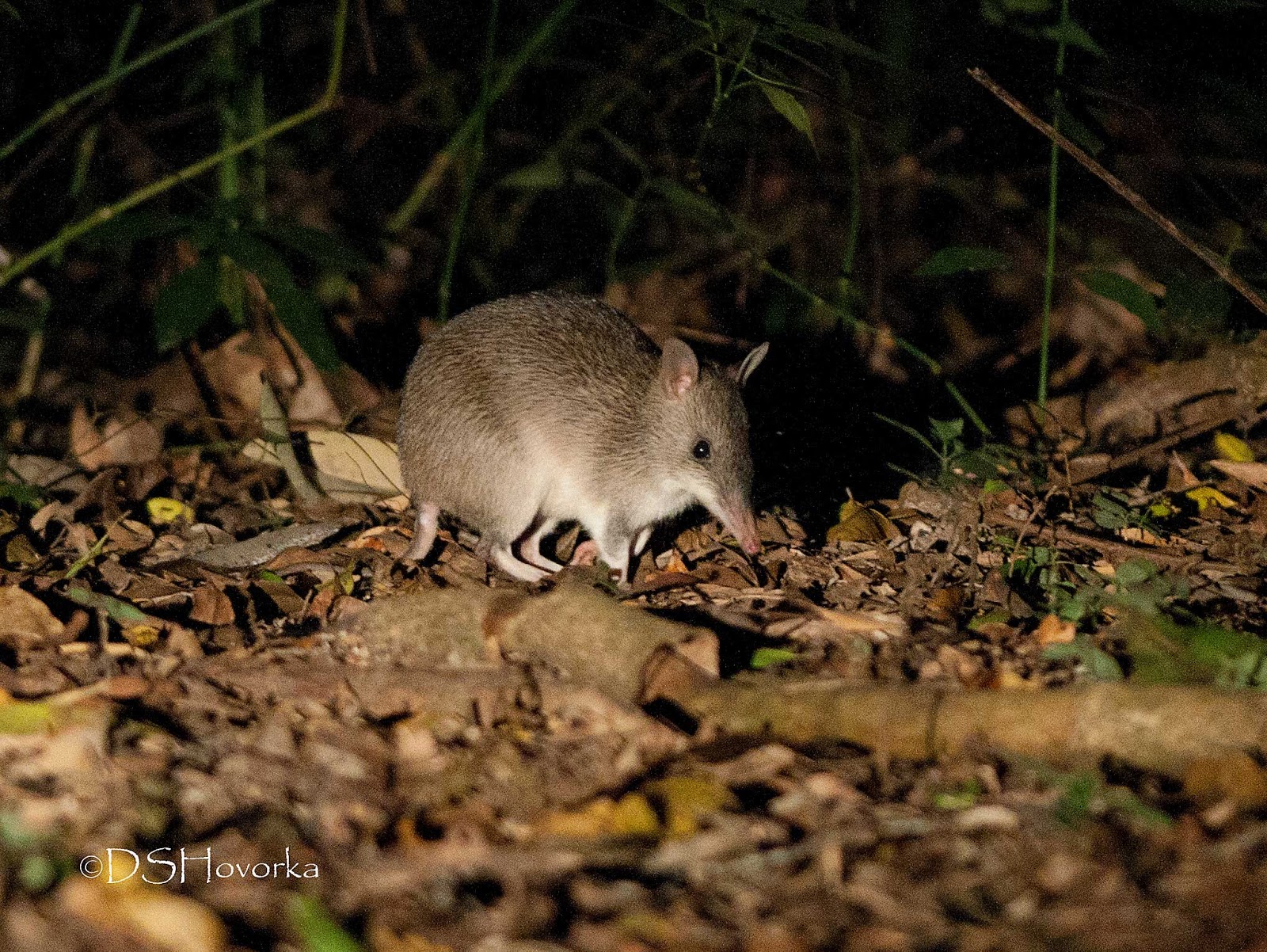
Also out in the dark were Long-nosed Bandicoots snuffling about in the leaf-litter looking for tasty critters to eat. We had seen these fellows earlier  whizzing across the road near Lake Eacham, but this guy was far less manic and watched us for a bit...


And his cousin the little Brown Bandicoot (notice the small rounded ears)


A local wetland hosted hundreds of  Plumed Whistling Ducks. Here they are following the leader out into deep water --- or something


.....Coming in en masses to land.....


I spotted large green movements in the trees along the road - investigation revealed a flock of Red-winged Parrots. I kept telling Nancy "sure- sure I see why they are called that--sort of. Yeah, kind of red(ish) wings............"

...


Then I saw the male ---who exemplifies the name!
We had to make a pilgrimage out to some grasslands in search of - yep. Australian Bustards. That's them out there periscoping...... As they stand 3' tall that's some mighty high grass!


Australian recycling -need a new mailbox?
I have some old white-goods!


Or... a  new form of drive-thru kitchen......

Spectacled Monarch coming in for afternoon bath


The creek through Kingfisher Park was the place to be late afternoon. Dozens of birds came in for a drink and a bath. Here is Rufous Fantail heading jumping in....


and then winging back to the woods.


In search of the (still) elusive Blue-face Parrot Finch....

Sunday, October 7, 2012

186) Kangaroos don't live in trees! Do they?

Lummholz Tree Kangaroo
These guys are only found in the Atherton Tableland region of Queensland.  Look at the arms on this guy--those are climbing arms, no wimpy limp-wristed normal kangaroo arms!


One more picture of the glorious Golden Bowerbird carefully arranging a new set of berries to attract the gals!


We were really thriled as we drove up through the town of Mt Malloy and Nancy excitedly spotted this Olive-backed Sunbird when Dirk and Claire went for coffees. These birds were unexpected as we were early in the season but the locals told us a few winter over due to the mild climate and peoples' flower gardens!


A female Sunbird posing in the garden tree, looking lovely in yellow.


Also in Mt Malloy, was a resident Great Bowerbird. He lived on the main street right next to the post office and seemed altogether unperturbed by either the cars of the people walking by. But then again, there is something on this look suggesting he won't abide my messing with his stuff! (a great collection of green glass, snail shells, white rocks, aluminum foil. bits of plastic)


He came out to straighten up - note how he shifted that piece of glass to the left? And the small shell has been turned over. Have to get the decoration just right if the right girls is coming to visit!


A delightful Spectacled Monarch. These were quite common-and vocal!


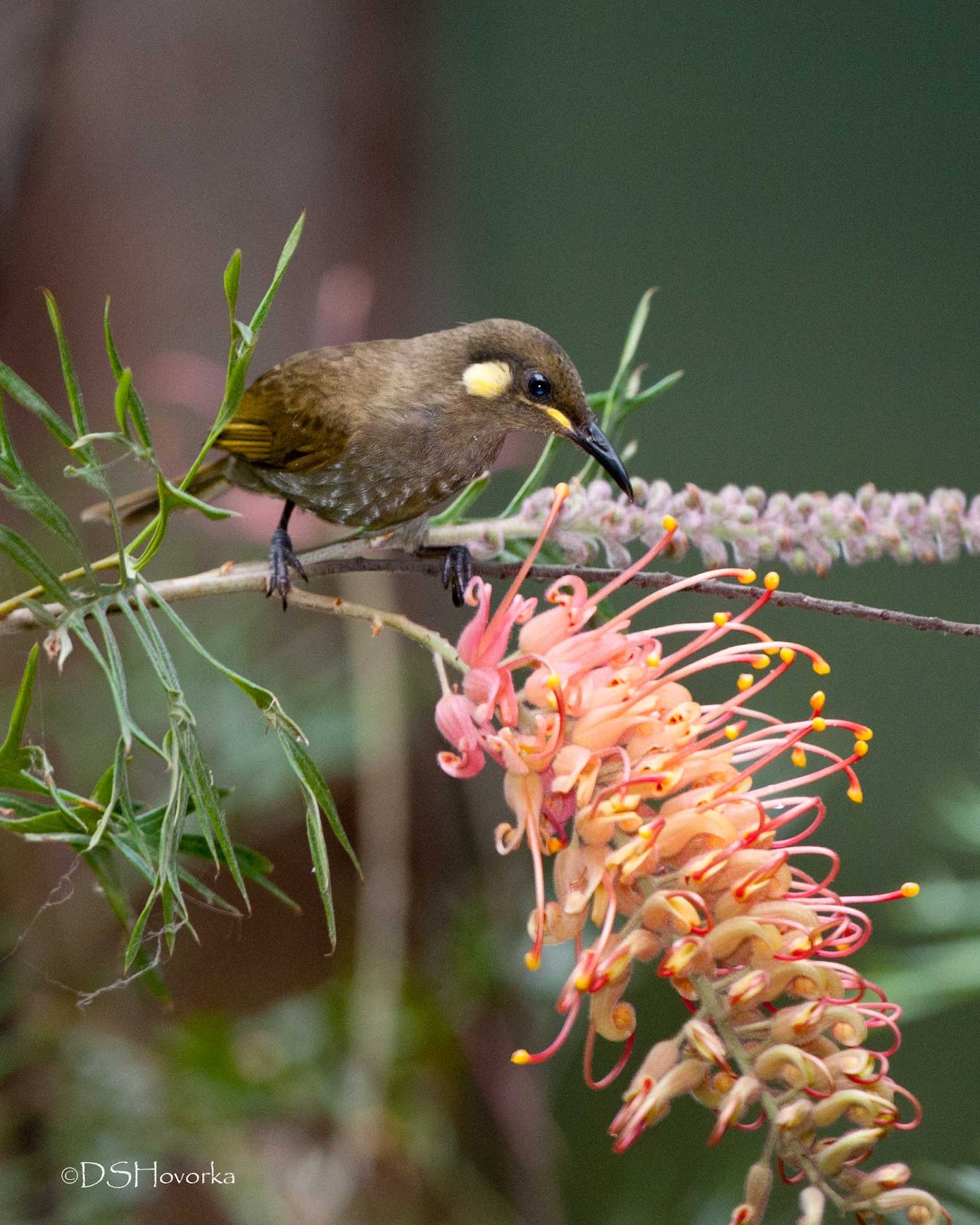
AH, now is this the Graceful or the Yellow-spotted Honeyeater? I can't even tell the difference looking at the illustrations in the guidebook! But Nancy and Claire assure me that this is the Graceful.

I think. Now I just have to find the other Yellow-spotted.

Except I can't tell the difference ---until I show them the pictures and they say "oh yeah, that's still the Graceful - keep looking!"

Chim chiminey
Chim chiminey
Chim chim cher-oo!
Good luck will rub off when
I shake 'ands with you
Or blow me a kiss
And that's lucky too!

These Brolgas elicited many amused chuckles as they put down their landing gear and floated rather erratically into the Bromfield Crater, like Mary Poppins with her umbrella, to roost for the night with all their buddies.

For many years, people didn't realise that Brolgas and Sarus cranes were different birds because they look so similar and hang out peaceably together.  These are Sarus cranes, because the scarlet-colored skin reaches down the upperneck, and they have pink legs.  Brolgas have red just around the back of their heads, black legs, and the males have a black dewlap under their chin, if you get that close to see, which is not likely. 


 Unless you have a super-duper scope like the one we carefully borrowed (and now we have scope-envy).


The aptly named Blue-faced Honeyeater


Next: We continue north to the Daintree.

Sunday, September 16, 2012

185) Atherton and environs

Pied Monarch

As mid-August was a break between semesters for Dirk, we decided it was time to head north to the "Wet Tropics" - flying into Cairns (pronounced "Kans") and touring the Atherton Tablelands and the the Daintree rainforest. We convinced Claire Runge (a fellow PhD student at UQ and birdo extraordinaire) to come along.

We had time after flying, shopping for food and driving up to Yungaburra to head out to meet Alan Gillanders for a quick bit of night-spotting.

This Green Ringtail possum has an utterly toxic (Eucalyptus leaves) diet but, like the Koala, has found an empty niche with plenty of food.

We also saw the coppery phase of the common brushtail possum, giant (arboreal) White-tailed Rats that can chew through coolers to get food, long-nosed and northern brown bandicoots, and a leaf-tailed gecko. 

No sign of the famed tree kangaroo this night.....


Alan Gillanders is a 35-year resident of the Tablelands who is a superb guide, naturalist, story-teller and splendid bloke for a day getting acquainted with the area.

We quickly spotted a number of the endemics including this Pied Monarch.


We walked a trail above Lake Eacham which Alan described as the "male red-light district" for Tooth-billed Bower birds. We heard 5 distinct males calling in about 1/2 km. Their "bower" is a set of large leaves arranged upside-down on the ground and they were rather vocal about getting the girls to show up and check out their handiwork!


We also headed to Mt Hypipamee where birding includes a  safety lecture! What to NOT do if confronted with a Cassowary (e.g. don't run).


The picnic area surfaced another endemic - the Grey-headed Robin.


A major find for us was the Golden Bower Bird. Alan is a specialist in these birds and has studied them for 30+ years. What a sight to behold!


As Nancy and Claire looked with Alan for an elusive Fernwren and Atherton scrubwren, I ran back up to get a picture of the Golden Bower-bird bower. I had to take a wide angle lens to fit it all in - it was about 3.5 high (apparently this was a young bird - the bower is small, the decorative mosses and flowers (lower L of picture) were mixed together and the bower was not symmetrical --there should be two towers with the decorations between them.)

Still, pretty cool that such a small bird can drag all those sticks into this structure!


I was only about 4 feet away - as I checked my exposures, the owner showed up with a flower to add to his decorations! I didn't even want to twitch as he carefully arranged the flower in with the others, took one last look at the arrangement and flew off. Absolutely made my day.....

More to follow.........

184) What kind of country is this anyway!

After two really wet years, with Lake Eyre filling three consecutive times, we may be back into a dry spell. 146 days with no rain in the red center - this is what happens......

The record dry spell was in 1972 - 147 days!

Near Mt Connor, 325 miles south of Alice Springs.
Photo from theaustralian.com.au


Sunday, August 19, 2012

183) A Fine obsession

Diamond Firetail

 I have only seen Diamond Firetails three times and we knew they were near Giraween National Park for the winter. Nancy was busy with a university session so I drove the 4.5 hrs to find them. I spent every morning (20 degrees at night) and evening walking the road and sitting on the edge of the meadow where they congregate. I have some nice photos but all pretty far away - they are VERY skittish birds.


 So the next weekend we decided to go to Bald Mountain (the largest granite blob in QLD) and went via Girraween. Back out walking the road, we saw a flock in flight - amazing!! They landed in a tree with no leaves, and there they were--16 little puffballs, backlit by the morning light, glowing with golden glow like heirloom Christmas tree ornaments with red ribbons.  Finally, after patient pursuit (sitting really), some of the firetails popped up on a fence close enough to catch some pictures of them in their full beauty.


The Eastern Yellow robin. These guys seem to show up everywhere. I always take pictures as they are really accommodating!  Their yellow feathers simply glow, especially in the dark rainforest where we often see them.  Almost as if they have some kind of fluorescence to them.


Turquoise parrots are a treat to see, such stunningly coloured feathers.  
A pair of Superb fairy wrens jockeying for the sunny (and warm) side of the sun and companion bird sandwich.  When you weigh 1/2 ounce and are only five inches long, every bit of solar energy counts on a cold (-5 C), breezy morning.


 A female Satin Bowerbird up with first light. Great fun to listen to as they chatter at each other - sounds a bit like R2D2!! (check out the call at http://www.birdsinbackyards.net/species/Ptilonorhynchus-violaceus - call located on right of page about 1/2 way down)

A White-cheeked Honeyeater
Nope -- not contacts or photoshop! The incredible purple eye of the male Satin Bowerbird
 Contemplating my inner navel on Bald Mountain.


 More Diamond Firetails - as I mentioned- a fine obsession!


Monday, July 9, 2012

182) Playing a long game

Noisy Pitta
I am beginning to think that bird photography is like Aikido or a Zen koan- or visa versa. It happens when you are looking and not looking, are present but not demanding. Some days it just happens. We were headed back to the car after another dip on getting a good pardalote picture when our local Pitta hopped on a branch in the sun! Now this is a shy bird, known for staying in dense, dark thickets - I have been happy to glimpse him much less get a clear line. He sunned for about 90 secs before heading off into the shadows

Quick now, how do I get this flash turned off?


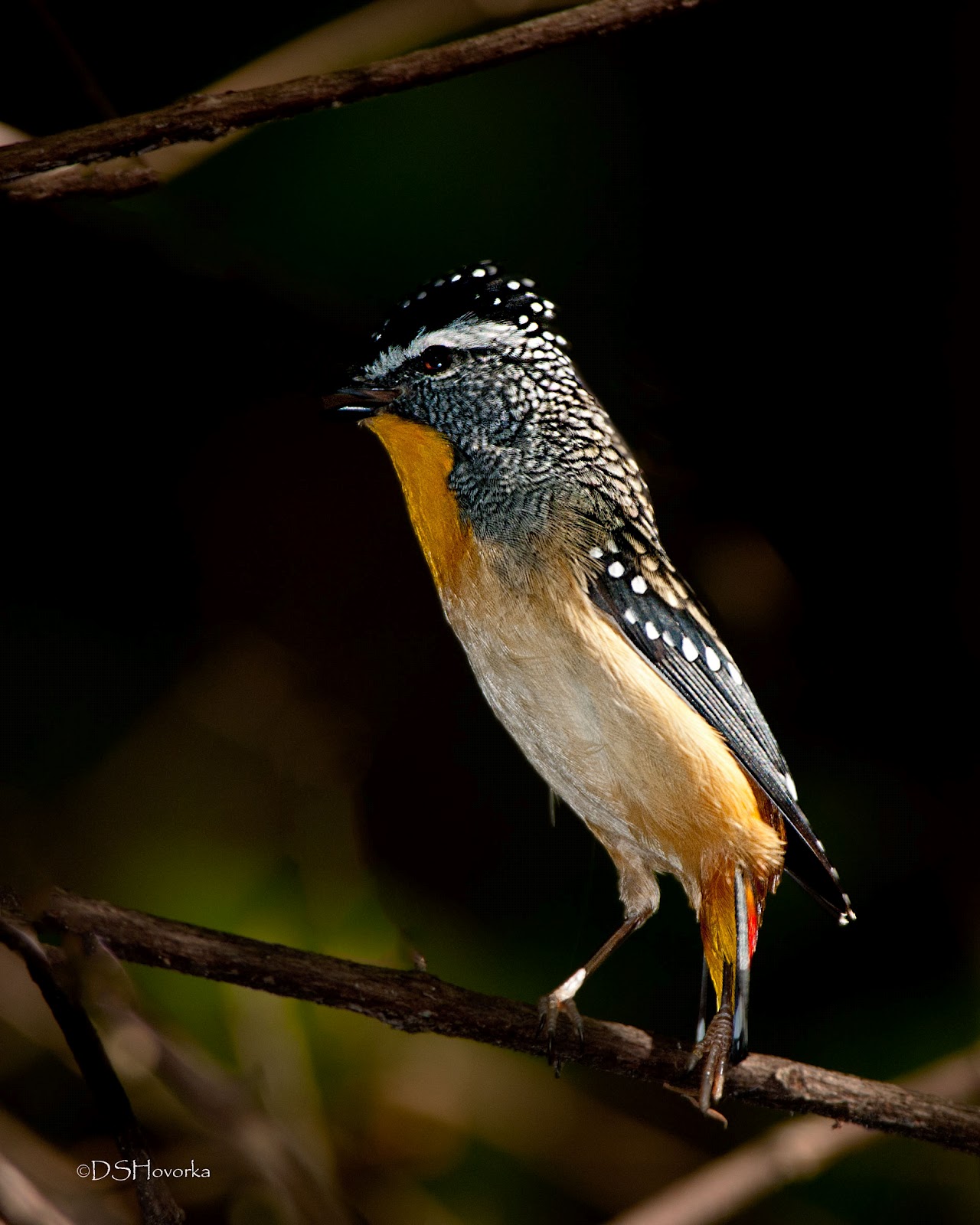
Today I was headed back to the car to go to the Uni and this Spotted Pardalote (who I had been tracking by his call through the bush for 30 min) suddenly landed on a branch 30 feet away and called and called and called (note the erect posture and raised "mohawk". It is hard to believe such a tiny bird  makes a call you hear 1 km away!). But this photography stuff is a long game - he would not turn to let me get a photo of his spectacular red tail feathers!


Usually -just- too far for a good picture, the Red- Backed fairy Wren  has previously only offered very brief close views. But at Eagleby this beautiful guy came to sit on a  branch for about 60 secs.


Another on my list of distant canopy feeders, I finally found  this Scarlet Honeyeater  lower in the branches.


 At Sundown the banksia were in bloom and there were dozens of New Holland Honeyeaters.
 I know the feeling -a remarkable yawn (!) from a Black Shouldered kite. (really now, do birds yawn?)

The Red Browed finches are about in force. It is great fun to see them out in the clear

Monday, July 2, 2012

181) Locally far away

Although Dirk's quest for the perfect pardalote picture continues, this one's pretty darn good!  The spotted pardalotes weren't calling (how we usually find them), so a big thumb's up to Claire for spotting the spotted pardalote high up in the tree hanging with the other leaves!


We learned from Claire (researching migrants) that these silvereyes (Zosterops lateralis) are migrants from Tasmania, coming up to join us in the subtropical climes for the winter.


If you want to know how the Silvereyes (above) get to be so pretty, we learned the secret!  Here's two Silvereyes canoodling on a branch.  First, the guy on the left prepared by fluffing out his head feathers and getting a dreamy-googley-eyed vacant expression on his face that signified "do me, baby!"  The bird on the right complied by preening him.  Next, the bird on the right assumed the wild-haired 'do me baby' expression, and the coiffed bird on the left complied.  It was really quite sweet, seeing them reveling in their morning ablutions so affectionately!  Ok, a little anthropomorphizing was called for in this situation--too cute!


Portrait of a white-plumed honeyeater displaying his namesake.